Manage cookies that are used for advertising, such as ad personalization, remarketing, and ad effectiveness analysis.
8.2.19. Configure SSL for MySQL
When a certificate is installed or removed, the instance is restarted.
TLS/SSL encryption is used to secure data transmitted between the client and the server. Follow these instructions to configure encryption using your own SSL certificate with hostname validation.
- Generate the certificate and key files (in the command, replace
example.mysql.networkin two lines with the host address of your instance):openssl req -x509 -newkey rsa:2048 \ -sha256 -days 365 \ -nodes \ -keyout server-key.pem \ -out server-cert.pem \ -subj "/CN=example.mysql.network" \ -addext "subjectAltName=DNS:example.mysql.network" \ -addext "keyUsage=digitalSignature,keyEncipherment" \ -addext "extendedKeyUsage=serverAuth" - Install the certificate in the "MySQL" section on the "Settings → SSL" tab (leave the private key password field blank if you did not specify one when generating the certificate and key):
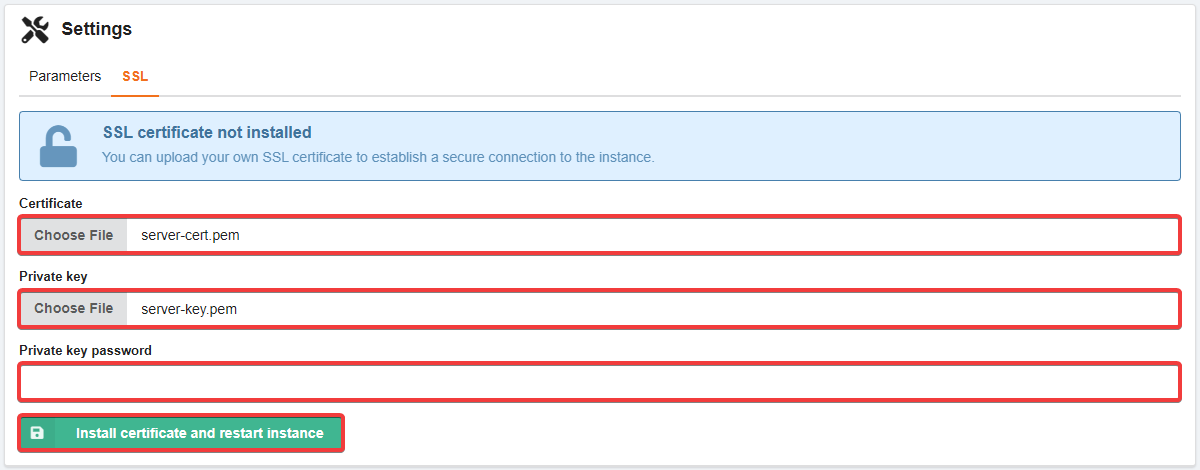
- Check the host address in the installed certificate (use your connection credentials in the command:
example.mysql.network— host,12345— port):openssl s_client -connect example.mysql.network:12345 -starttls mysql -showcerts </dev/null 2>/dev/null | openssl x509 -noout -subject -issuer -ext subjectAltNameWithout a certificate installed, the output looks like this:
subject=CN = MySQL_Server_8.0.36-28_Auto_Generated_Server_Certificate
issuer=CN = MySQL_Server_8.0.36-28_Auto_Generated_CA_Certificate
No extensions in certificate
After installing the certificate, the output will show the host address of your instance:
subject=CN = example.mysql.network issuer=CN = example.mysql.network X509v3 Subject Alternative Name: DNS:example.mysql.network - Connect to the instance using a certificate and make sure the connection is encrypted (use your connection credentials in the command:
example.mysql.network— host,12345— port,user— username):mysql -h example.mysql.network -P 12345 -u user -p \ --ssl-mode=VERIFY_IDENTITY \ --ssl-ca=server-cert.pem \ -e "SHOW STATUS LIKE 'Ssl_cipher'; SHOW STATUS LIKE 'Ssl_version';"If everything is configured correctly, the connection is established successfully, and the output looks like this:
+---------------+------------------------+
| Variable_name | Value                  |
+---------------+------------------------+
| Ssl_cipher    | TLS_AES_256_GCM_SHA384 |
+---------------+------------------------+
+---------------+---------+
| Variable_name | Value   |
+---------------+---------+
| Ssl_version   | TLSv1.3 |
+---------------+---------+
When connecting to the instance via a MySQL client, select the VERIFY_IDENTITY mode and use the server certificate as the CA certificate. Do not specify a client certificate or key.