Manage cookies that are used for advertising, such as ad personalization, remarketing, and ad effectiveness analysis.
8.2.9. MySQL users
Users are managed in the "MySQL" section on the "Databases" tab — the list is expanded by the "Users" button: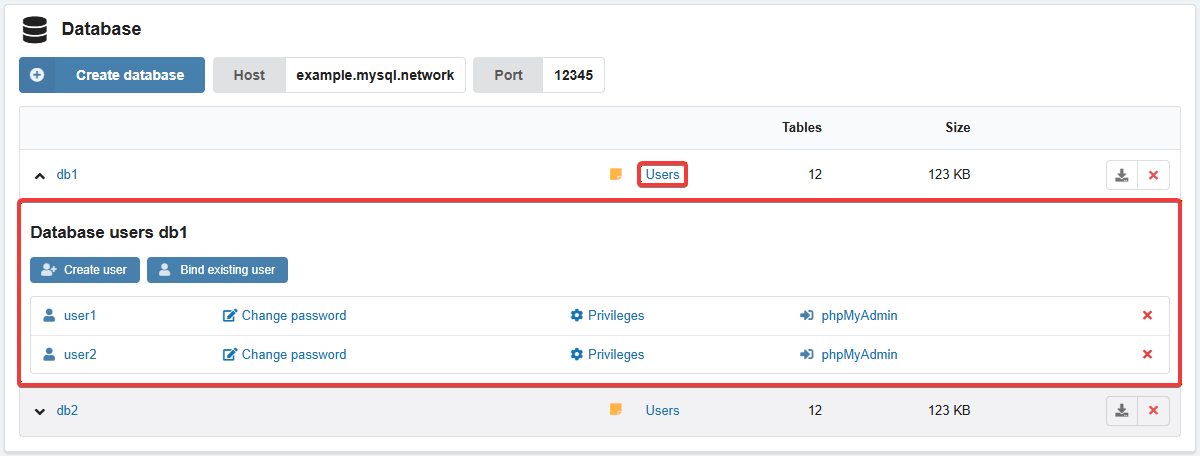
The list of all users and database binding information is displayed in the "MySQL" section on the "Users" tab:
Create
Notes:
- When you create a database, you can immediately create a user for it with the same name and full privileges.
- By default, the modern authentication method caching_sha2_password is used. Use the outdated mysql_native_password authentication method only if your MySQL software does not support the modern method.
- On the "Databases" tab in the user list, click "Create user".
- Enter login and password, select authentication method, privileges and click "Create".
Bind
- On the "Databases" tab in the user list, click "Bind existing user".
- Select one or more users, select privileges, and click "Bind".
Changing password and authentication method
Attention!
User passwords are not stored publicly on the hosting. If you lose your password, you can only set a new one.- On the "Databases" or "Users" tab, in the user row, click "Change password".
- Enter a new password, select authentication method and click "Change".
Configure privileges
- On the "Databases" tab, in the user row, click "Privileges".
- Select the privileges and click "Change".
Log in to phpMyAdmin
- On the "Databases" tab, in the user row, click "phpMyAdmin".
- Enter the password (login is filled in automatically) and click "Log in".
Delete
When a user is bound to two or more databases at the same time, the user is not deleted, but only unbound from the current database. When bound to only one database, it is deleted.
On the "Databases" or "Users" tab, in the user row, press ❌ and confirm the operation.