Manage cookies that are used for advertising, such as ad personalization, remarketing, and ad effectiveness analysis.
2.6.1.2.1.8. Terminate processes using phpMyAdmin
You can quickly terminate all database queries at once in the control panel.
Important points:
- The "Status" section is displayed only when no database is selected in the left-hand menu. If a database has been selected, simply click on the server name at the very top of the page, which appears as
Server: example.mysql.ukraine.com.ua. - When you open the page displaying current processes, at least one process with the query
SHOW PROCESSLISTwill always be shown. This query cannot be closed because it is executed to display the page with current processes. - If you see the error message "phpMyAdmin was unable to close thread ID XXXXXX. It may have already been closed", refresh the page by clicking "Refresh".
- We strongly advise against enabling auto-updates with short intervals on a long-term basis, as this may place an additional load on the database server and consume CPU minutes/resources included in your plan.
- When using the SQL query
SHOW PROCESSLIST, errors may occur when terminating processes due to a lack of required privileges. In such cases, you should terminate the processes by following the instructions provided here.
Each database connection runs in a separate process (thread). If necessary, these processes can be forcefully terminated.
- Log in to phpMyAdmin.
- Go to the "Status → Processes" section and click "Kill" next to the desired process:
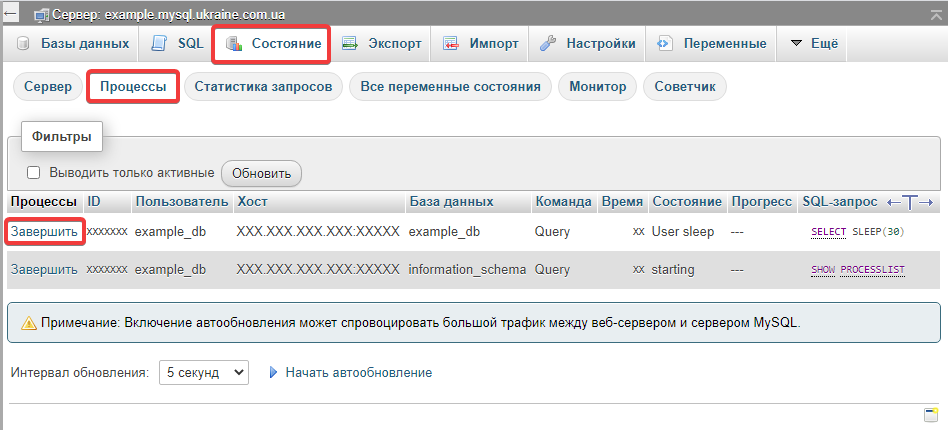
- Confirm the operation by clicking "OK".
(1)
Comments